How to Create a First Day of School Tradition Your Kids Will Remember
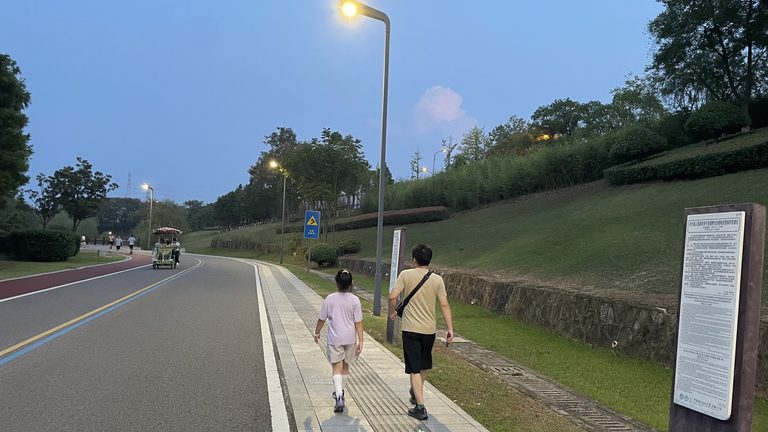
Ask most adults about their favourite childhood memories, and you’ll rarely hear “the vacation to X” or “the birthday party at Y.” More often, it’s the small, repeated things — the same pancakes every Saturday, the same song on the way to school, the same spot for the first day photo every single year.
Traditions don’t need to be elaborate to matter. In fact, the ones that stick are usually the simple ones, because simple is what actually survives a busy Tuesday morning in September.
Here’s how to build a first day of school tradition that your family will actually keep up, year after year, without it becoming one more thing on the to-do list.
Start With One Thing, Not Five
The biggest reason traditions don’t stick is that they start too big. A tradition that requires a special breakfast, a themed outfit, a professional-looking photo shoot, and a handwritten card is lovely — for exactly one year. By year two, it’s a burden. By year three, it’s forgotten entirely.
Pick one small anchor instead:
- A photo in the same spot every year
- A quick written record — height, favourite thing, one sentence about how they’re feeling
- A specific breakfast that’s just for this one day
One consistent thing, done every year without fail, becomes more meaningful over time than five things done inconsistently.
Make It Fast Enough to Survive a Busy Morning
If your tradition takes fifteen minutes on a morning where everyone is already running late, it will quietly disappear within a few years — not because you don’t care, but because mornings are mornings.
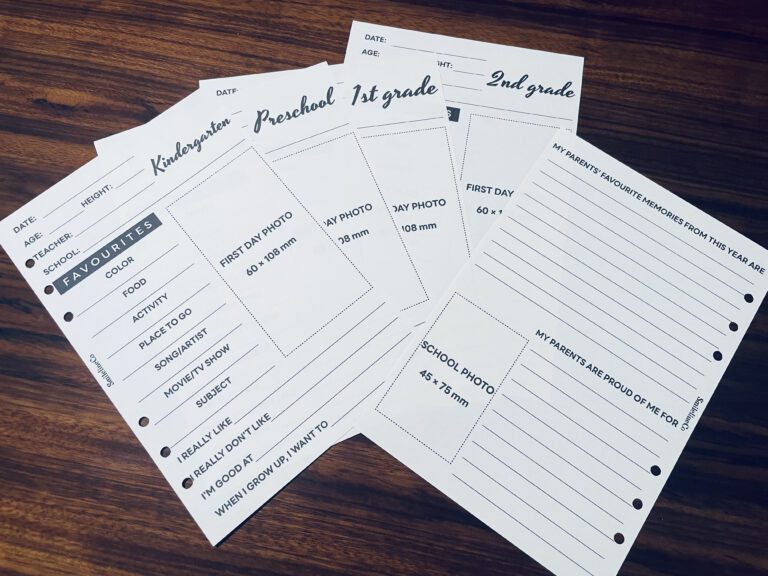
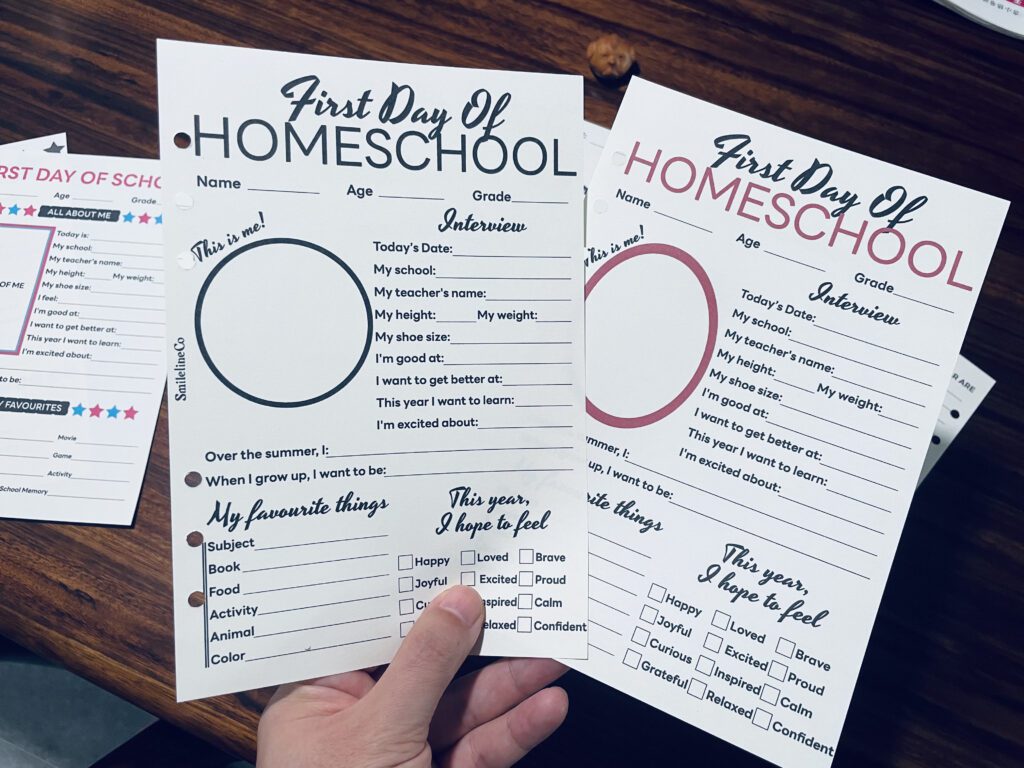
A good first day of school tradition should take two to five minutes, max. This is exactly why a simple printable works so well here: it turns “sit down and think of something meaningful to say” into “fill in five blanks,” which is realistic even on a chaotic morning.
Same Spot, Same Angle, Every Year
If photos are part of your tradition, the single best trick is choosing one consistent location — the same front door, the same wall, the same porch step — and sticking with it.
It won’t look like much in year one or two. But by year five or six, lining those photos up side by side becomes genuinely emotional — you can watch your child grow up in a way that scattered, random photos never quite capture.
Let Your Child Answer the Questions Themselves
It’s tempting, especially with younger kids, to fill things in for them. Resist that as much as possible. The charm of a good tradition isn’t a polished, “correct” answer, it’s the honest, sometimes hilarious things kids actually say.
“When I grow up, I want to be a dinosaur doctor.” “My favourite food is air.” “I’m excited about lunch.” These are the lines that make you laugh out loud reading them back in five years, and they only happen if the child is the one holding the pen.
Write Something Down, Even If It’s Short
A photo captures what your child looked like. A few written words capture who they were, what they cared about, what made them laugh, what they were nervous or excited about. Ten years from now, the writing is often what hits harder than the photo.
You don’t need a long journal entry. Even a single line, “This year, she’s obsessed with painting and terrified of the school bus”, becomes a small time capsule.
Involve the Whole Family, Even in a Small Way
A first day of school tradition doesn’t have to be just for the child. Adding a tiny prompt for parents, “This year, I’m proud of them for…” or “My favourite memory from this year was…”, turns the tradition into something the whole family contributes to, and it often becomes the part everyone looks forward to reading back the most.
Store It Somewhere You’ll Actually See It Again
A tradition only pays off if you revisit it. Keep every year’s record in the same place — a binder, a folder, a specific drawer, so that flipping through years of first-day pages is easy, not an archaeological dig through old boxes.
Label each page with the year. Keep them in order. Make it something you can hand your child on their eighteenth birthday, not something you have to go hunting for.
The Real Goal: Consistency Over Perfection
The families with the most meaningful first day of school traditions aren’t the ones with the most elaborate setup — they’re the ones who did the same small thing every single year without skipping.
Start simple. Keep it under five minutes. Let your child answer honestly. And trust that the tradition’s value isn’t in how impressive it looks this year — it’s in how much it means when you look back on all of them together.
Give Your Tradition a Home
A tradition needs a consistent format to actually stick — here are three printables to anchor yours, whichever style fits your family:
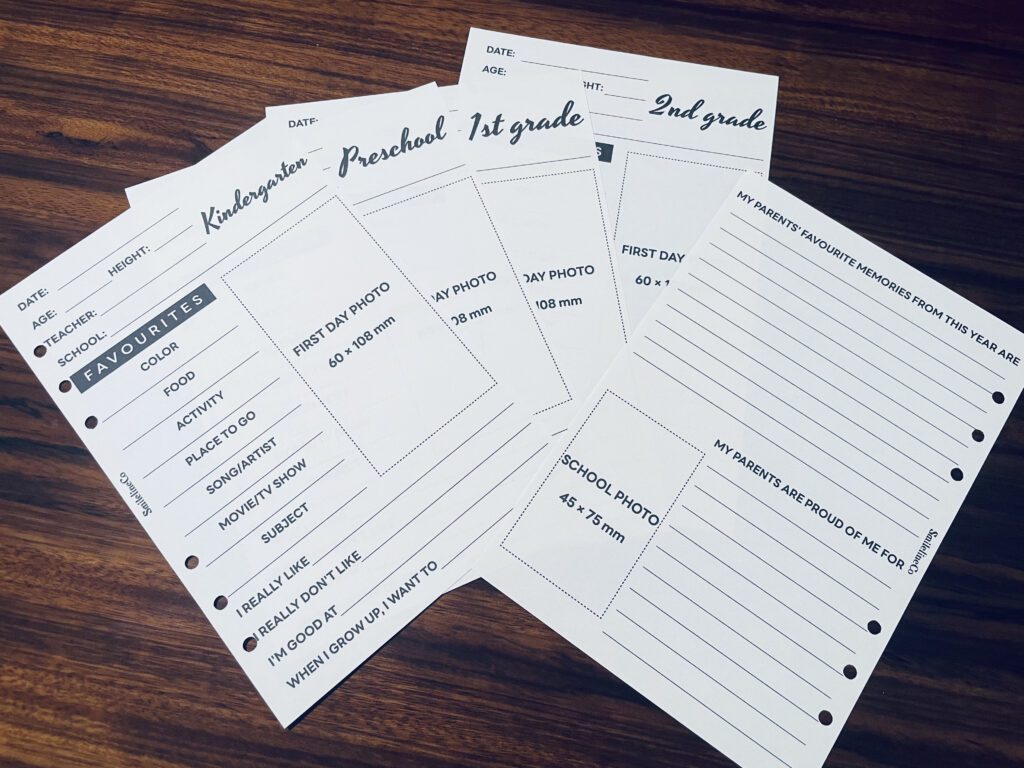
- #065 First Day of School Printables — a clean, minimalist record set (Kindergarten to 2nd grade) with a matching parent memories page
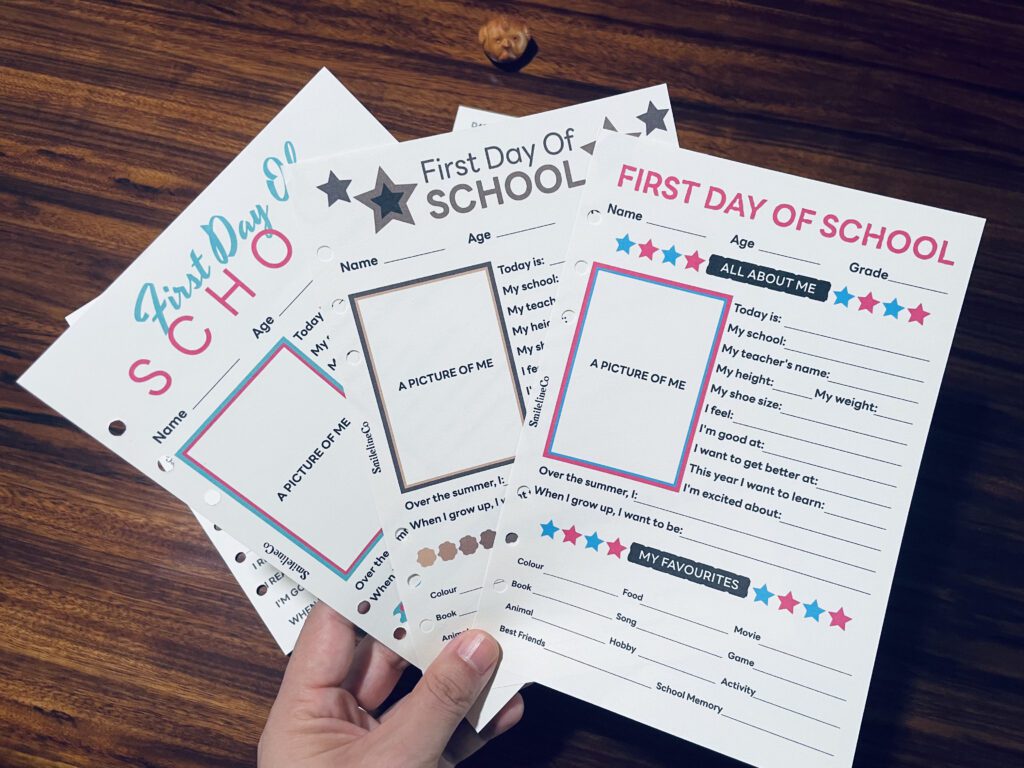
- #066 First Day of School Printable — a colorful, interview-style page for kids who like a bit more personality on the page
- #067 First Day of Homeschool Printable — designed for homeschool families, with a favourites section and a mood tracker
Pick one, print a stack at the start of the year, and let the tradition build itself from there.
Looking for More Systems Like This?
A first day of school photo is a great place to start, but it’s really just the opening page. Once the ritual sticks, it’s natural to want a whole system around it — birthdays, milestones, the little things your kids say — instead of scrambling to capture each moment separately as it happens.
Better systems, better days — that’s the whole idea behind SmilelineCo.
Looking for more free printables? Browse the [Free Printables Library →] for every free download we offer, new pages added regularly.
Want a full planning system instead of a standalone checklist? The [Complete Systems →] collection bundles pages like this one into something bigger, designed to work together across your whole routine — and you can browse everything directly in our [Shop →].
Setting up your own printing station? Our [Printing & Planner Supplies →] page has the exact printer, paper, and tools we use to go from PDF to finished page.