The Feynman Technique: How to Actually Understand What You Learn
You read the chapter twice. You highlighted the important parts. You watched another explanation.
Then someone asks you to explain the idea without looking at your notes.
And suddenly…
Nothing.
You know the words. You recognize the diagram. You remember seeing the concept somewhere. But you can’t actually explain it.
That uncomfortable moment is useful.
Because recognizing information is not the same as understanding it. And that’s where the Feynman Technique can help.
Instead of asking yourself, “Have I read this before?”, it asks a much better question:
“Can I explain this clearly without hiding behind the original words?”
What Is the Feynman Technique?
The Feynman Technique is a learning approach built around a simple idea: one of the best ways to test your understanding is to try explaining something in plain language.
The method is named after physicist Richard Feynman, who became well known for his ability to explain complicated ideas clearly.
Modern versions of the technique are usually organized around four basic steps:
- Choose a concept.
- Explain it simply.
- Identify where your explanation breaks down.
- Go back, fill the gaps, and simplify again.
Caltech’s learning resources describe a very similar approach: study the material, set the notes aside, explain the idea from scratch, notice where you get stuck, return to those weak spots, and simplify your explanation further.
The important part isn’t memorizing those four steps.
It’s what the process reveals.
You discover what you don’t actually know.
Why Do We Often Think We Understand Something When We Don’t?
This happens to almost everyone.
You read:
“Compound interest is the addition of interest to the principal amount, including previously accumulated interest.”
You think: “Yep. Makes sense.”
Then somebody asks:
“So why does compound interest become much more powerful over longer periods of time?”
Suddenly your explanation gets fuzzy. You may start repeating the definition. Or reach for a formula.
Or say:
“Well… basically, it’s interest on interest.”
That’s not necessarily wrong. But if you can’t explain how or why it works, there’s probably a gap somewhere.
This is one of the most useful ideas behind the Feynman Technique:
Confusion is information.
The place where you get stuck tells you where your next study session should go.
The 4 Steps of the Feynman Technique
Step 1: Choose One Specific Concept
Don’t choose something enormous.
“Learn economics” is not a useful Feynman Technique topic.
Try:
- What is inflation?
- How does compound interest work?
- Why does supply and demand affect prices?
- What is photosynthesis?
- How does a mortgage work?
- What is opportunity cost?
The smaller the concept, the easier it is to identify exactly what you understand.
Step 2: Explain It in Plain Language
Now put your notes away.
Pretend you’re explaining the concept to someone intelligent who knows absolutely nothing about it.
Don’t worry about sounding academic. Actually, that’s the point.
If you can explain something only by repeating textbook language, you may know the vocabulary without fully understanding the idea.
Try phrases like:
“In simple terms…”
“What this really means is…”
“A simple example would be…”
“Imagine that…”
This forces your brain to reconstruct the idea instead of simply recognizing it.
Step 3: Find the Gaps
This is where the technique becomes interesting.
Pay attention to the moments when you:
- suddenly become vague
- use a technical term you can’t explain
- skip an important step
- contradict yourself
- need to look at your notes
- realize you don’t know why something happens
Don’t erase those mistakes. Mark them. Those are your study targets.
Instead of saying:
“I’m terrible at this.”
Try:
“I just found the part I need to understand.”
That small change in attitude matters.
Step 4: Go Back, Fix the Gap, and Simplify Again
Return to the textbook, lecture, article, video, or other reliable source. But don’t reread everything.
Go directly after the gap you discovered. Then close your notes and explain the concept again.
If the explanation still feels complicated, simplify it further.
Add an analogy. Create your own example. Connect it to something you already understand. Then try again.
The goal isn’t to make your explanation childish.
The goal is to make it clear without losing the essential idea.
A Simple Example: Learning Compound Interest
Let’s say you’re trying to understand compound interest.
Your first explanation might be:
“Compound interest means you earn interest on the original amount plus the interest that has already accumulated.”
Pretty good.
But let’s test it.
Why does time matter so much?
You might realize that you understand the definition but don’t fully understand the growth process. That’s your gap.
So you go back and study an example. Suppose you invest $1,000 and earn a return. At first, the growth may look unimpressive. But as the balance grows, the amount generating the next round of growth also becomes larger.
Now try explaining it again:
“Compound growth is powerful because the growth you earn can become part of the amount that grows next. The longer the process continues, the more opportunities there are for growth to build on previous growth.”
That’s a much deeper explanation.
Notice what happened. You didn’t simply memorize a better definition. You found the missing relationship.
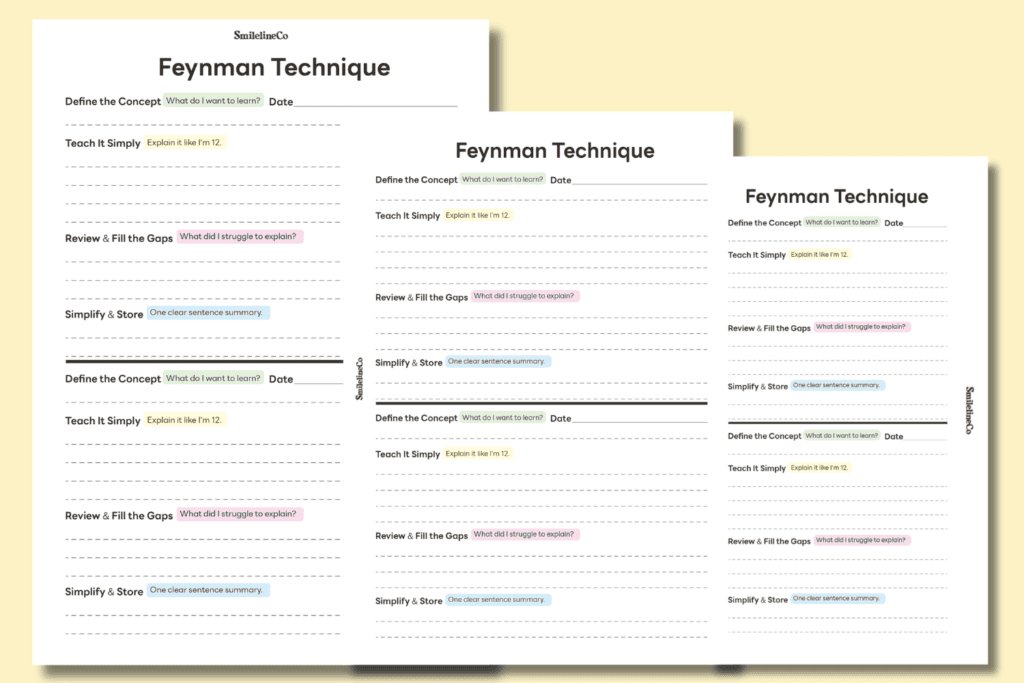
Turn the Feynman Technique from an idea into a repeatable learning habit.
Why Writing the Explanation Down Can Be So Useful
You can certainly use the Feynman Technique verbally.
But writing has one major advantage: You can’t hide your confusion quite as easily.
When you’re talking, it’s easy to say:
“You know, it’s kind of like…”
and keep moving.
On paper, the blank space is obvious. You can see exactly where your explanation becomes incomplete. That’s why a simple worksheet can be useful.
Instead of starting with an intimidating blank page, you have somewhere to:
- define the concept
- explain it
- record the confusing parts
- revisit the gaps
- write the final simplified explanation
That’s exactly how I designed the Feynman Technique Printable Worksheet at SmilelineCo: one page gives you two complete learning cycles, with A4, A5, and Personal sizes available.
[Feynman Technique Printable Worksheet →]
The Feynman Technique Isn’t Just for Students
You don’t need to be preparing for an exam to use it.
It works particularly well when you’re learning something that requires genuine understanding.
Students
Use it for:
- biology
- physics
- economics
- history
- mathematics
- psychology
Professionals
Try it when learning:
- business concepts
- marketing
- finance
- technology
- new software
- industry knowledge
Lifelong Learners
It can be especially useful when reading books or articles about subjects you’re unfamiliar with.
And there’s another group that can benefit:
Content Creators
If you write about something, try explaining it before you publish.
If you can’t explain the idea clearly, that’s useful feedback.
You may not need more information. You may need better understanding.
When the Feynman Technique Isn’t the Best Tool
The Feynman Technique isn’t magic, and it isn’t the only learning strategy worth using.
If you need to memorize isolated facts, vocabulary, dates, or definitions, retrieval practice and spaced practice may be more appropriate tools.
In fact, effective learning usually involves several strategies rather than one universal method. Caltech’s learning resources, for example, highlight retrieval practice, spaced practice, elaboration, concrete examples, and other evidence-informed approaches.
Think of the Feynman Technique as particularly useful when your goal is:
“I want to understand this well enough to explain it and use it.”
A Simple Feynman Technique Challenge
Try this today. Choose one concept you’ve been learning recently. Close your notes. Set a timer for five minutes. Then explain the idea as clearly as you can. Don’t worry about being perfect. Notice where you hesitate. Those moments are the valuable part.
Go back. Fill the gap. Then explain it again. You may discover that the hardest part of learning isn’t remembering more. It’s realizing what you don’t yet understand.
[How to Use the Feynman Technique to Learn Finance →]
[How to Use the Feynman Technique for Difficult Books →]
[Feynman Technique vs. Active Recall →]
Final Takeaway
The Feynman Technique is simple enough to sound almost obvious. But that’s part of its strength.
You don’t need another complicated productivity system. You need a way to catch yourself when “this looks familiar” quietly turns into “I actually understand this.”
The next time you’re studying something difficult, don’t just ask:
“Have I read this?”
Ask:
“Can I explain it?”
That question can change the way you learn.