Feynman Technique vs. Active Recall: What’s the Difference?
If you’ve spent any time researching better study methods, you’ve almost certainly run into the same two names over and over again: the Feynman Technique and active recall.
From the outside, they can look like nearly the same thing. Both tell you to stop passively rereading your notes. Both force you to retrieve information instead of just staring at it. And both have a way of revealing exactly what you don’t actually know yet.
So it’s a fair question to ask, when people talk about Feynman Technique vs Active Recall, what’s actually different between them?
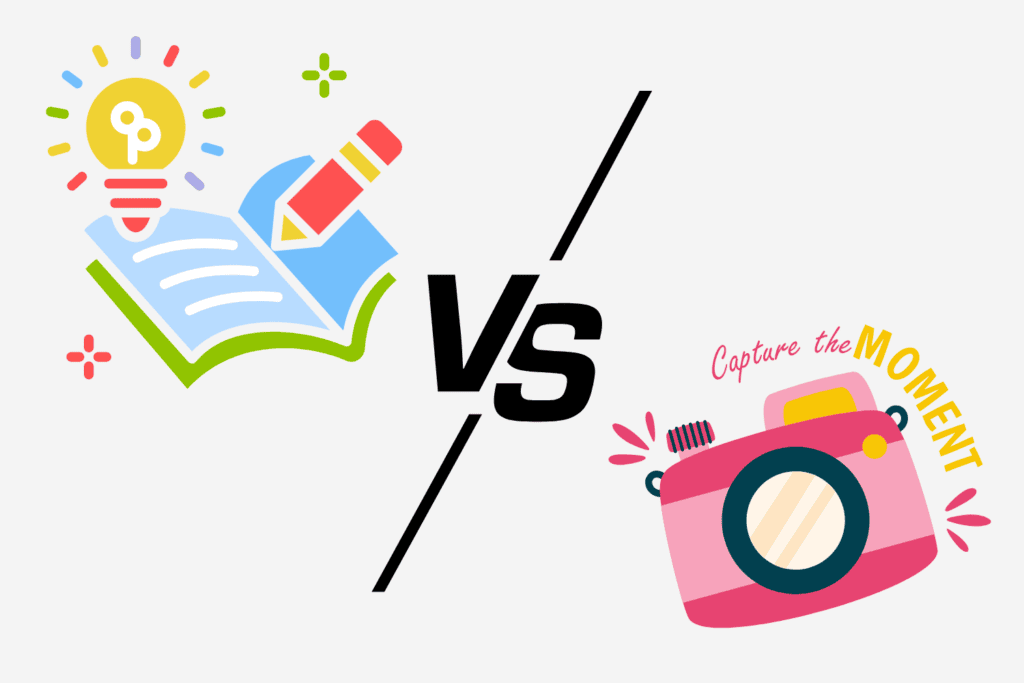
The short answer is this: active recall asks, “Can I retrieve this information?” while the Feynman Technique asks, “Can I explain this idea clearly?”
There’s real overlap between the two, and plenty of good reasons to use them together, but they’re solving slightly different problems, and once you see the difference between Feynman Technique and active recall, you’ll start choosing the right one for the right moment instead of just picking whichever one you heard about most recently.
What Is Active Recall?
Active recall, also known as retrieval practice, simply means deliberately trying to pull information out of your memory instead of looking at it again.
Instead of rereading the question “What are the three branches of government?” until it feels familiar, you close your notes and force yourself to answer it from memory.
Instead of staring at a vocabulary list hoping the words sink in, you cover the definitions and quiz yourself on what each word actually means.
Caltech describes retrieval practice as one of several evidence-informed learning strategies, sitting alongside approaches like spaced practice, elaboration, concrete examples, and interleaving.
The underlying idea is refreshingly simple: don’t just put information into your brain and hope it stays there, practice getting it back out again, on demand, without help.
What Is the Feynman Technique?
The Feynman Technique takes a slightly different angle on the same problem. Instead of asking “Can I remember this?”, it asks a harder question: “Can I explain this?”
You pick a concept, explain it out loud in plain, ordinary language, notice the exact moment where you stumble or go quiet, go back to the material to patch that gap, and then simplify your explanation one more time.
Caltech’s Feynman-related learning resource describes this same process, explaining a concept from scratch, identifying the places where you stall, filling in those specific gaps, and simplifying the explanation further until it actually holds together.
In short: active recall is about retrieval, and the Feynman Technique is about explanation. They sound similar, but they’re testing two different skills.
The Difference in One Example
Let’s make this concrete with something most of us have actually tried to learn: compound interest.
Using active recall, you might simply ask yourself, “What is compound interest?” and answer: “Interest earned on the initial amount, plus whatever interest has already accumulated on top of it.”
That’s a clean, correct answer, and it’s pure retrieval. You pulled a definition out of memory and moved on.
Using the Feynman Technique, you’d push further. You might write something like, “Compound interest means the growth your money earns can become part of the balance that grows again next time.” Then you’d ask yourself the harder follow-up question: “Why does this actually become more powerful over time?” And this is usually where people notice they can recite the definition perfectly, yet still can’t explain the mechanism behind it in their own words.
That gap — the space between knowing a definition and understanding why it works — is exactly what the Feynman Technique is built to expose. You go back, dig into the “why,” and try explaining it again until it finally clicks.
The Biggest Difference
Here’s the simplest way to think about it: active recall tests whether information is accessible, while the Feynman Technique tests whether your understanding is explainable.
Those are related abilities, but they’re not the same skill wearing a different name. It’s entirely possible to remember a definition word-for-word without truly understanding the idea behind it, plenty of students can recite “compound interest” flawlessly on a quiz and still struggle to explain why it matters.
And the reverse happens too: you can genuinely understand a concept deep down and still blank on a specific term, date, or number when asked to recall it cold. That’s exactly why using both methods together tends to work better than leaning on just one.
Feynman Technique vs. Active Recall: Comparison
| Feynman Technique | Active Recall | |
|---|---|---|
| Main goal | Understand and explain | Retrieve information |
| Main action | Explain in your own words | Recall from memory |
| Best for | Concepts and relationships | Facts, concepts, definitions |
| Reveals | Understanding gaps | Memory gaps |
| Typical format | Written explanation, teaching, simple examples | Questions, flashcards, practice tests |
| Can be combined? | Yes | Yes |
When Should You Use Active Recall?
Active recall shines whenever the real task in front of you is retrieving specific, well-defined information rather than untangling a complex idea. If you’re studying vocabulary and need to answer “what does this word mean?” on demand, active recall is the tool for the job.
The same goes for history dates (“what happened in 1776?”), the ordered stages of a biological process, or general exam prep where the honest test is simply: can I answer this question without glancing at my notes?
Think of active recall as a workout for retrieval, the more you practice pulling information out under pressure, the easier it becomes to do it again later, when it actually counts.
When Should You Use the Feynman Technique?
The Feynman Technique earns its keep when the real obstacle isn’t remembering a fact, but understanding why something happens, how something works, how separate ideas connect to each other, or how to explain a genuinely difficult concept to someone else.
It’s also the better choice when you need to apply an idea in a brand-new situation rather than just recognize it on a page. A good signal that you need Feynman rather than active recall sounds something like this: “I know what inflation means, but do I actually understand why it affects purchasing power?”
That’s not a memory problem, it’s an understanding problem, and it calls for a different tool.
The Feynman Technique turns “I kind of understand it” into a visible test of understanding.
Can You Use Both?
Absolutely, and honestly, this is probably the most effective way to study anything worth studying.
Say you’re working through a unit on economics. You’d start by simply reading the material and letting the concept sink in for the first time.
From there, you’d bring in the Feynman Technique: close your notes, explain what inflation actually is in your own words, notice exactly where your explanation falls apart, and go back to fix those specific gaps until the explanation holds together cleanly.
Once your understanding feels solid, that’s the moment to switch over to active recall. Close everything and ask yourself a run of direct questions: What is inflation? What causes it? How does it affect purchasing power? What are some possible responses to it? Now you’re not just checking whether you understand the idea, you’re testing whether you can retrieve it under pressure, the same way you’ll need to on an exam or in a real conversation.
Come back a few days later and quiz yourself again, and you’ve quietly added spaced practice into the mix as well. Chain all of this together and you get a genuinely strong learning cycle: learn, explain, fix, retrieve, revisit, each step doing a job the others can’t.
What About Note-Taking?
Neither method means you should stop taking notes altogether. The real problem isn’t note-taking itself, it’s passive note-taking.
If your typical study session looks like read, highlight, copy the sentence down, reread it, highlight it again, you can walk away feeling productive without ever actually testing whether you understood anything.
Caltech’s learning resources draw this same distinction, separating active learning from the passive receipt of information, and encourage students to regularly ask whether their current study habits are genuinely working or just feel like work.
A better question to sit with is simply: what am I actually doing with this information right now? Are you explaining it in your own words? Retrieving it cold, without help? Applying it to a new example? Connecting it to something you already know? Questioning the parts that don’t quite add up?
Those are the behaviors that separate real studying from simply spending time near your notes.
A Simple Study Session Using Both Methods
Say you have 45 minutes to work with.
Spend the first 10 minutes reading through the material and letting yourself genuinely understand it before you do anything else.
For the next 10 minutes, close your notes and run the Feynman Technique: explain the main concept out loud or on paper, and mark down exactly where the explanation gets shaky.
Spend the following 10 minutes going back into the material specifically to patch those gaps, not rereading everything, just the parts you flagged.
Then shift into active recall for 10 minutes: ask yourself direct questions about the material without looking anything up.
Finish with five minutes writing down, honestly, what you still don’t know. That last step matters more than it sounds like it should, it turns a vague sense of “I studied for 45 minutes” into an actual feedback loop, one where you know precisely whether the studying worked or just felt productive.
Which One Is Better?
Honestly, this might be the wrong question to ask in the first place.
It’s a bit like asking whether strength training is better than running, better for what, exactly? The same logic applies here. If what you need is to remember something specific, reach for active recall. If what you need is to actually understand something, reach for the Feynman Technique.
And if you want the real benefit of both, just use both, there’s no rule saying you have to pick a side. The goal was never to collect study techniques like trading cards. The goal is choosing the tool that actually matches the problem you’re trying to solve today.
A Simple Way to Remember the Difference
If you only remember one sentence from this whole comparison, make it this one: active recall asks you to retrieve, while the Feynman Technique asks you to explain.
And when you combine the two, the whole loop becomes wonderfully simple to describe: retrieve what you know, explain what you understand, and find what you’re still missing. That’s a far more useful way to spend your study time than reading the same page for the fifth time and hoping something finally sticks.
[ The Feynman Technique: How to Actually Understand What You Learn →]
[ Feynman Technique Printable Worksheet →]