What Is a Mood Tracker? Benefits, Ideas, and How to Use One
Some days are easy to remember. You had an amazing day, got good news, went somewhere fun, or had a conversation that stayed with you.
Other days blur together. You wake up, work, answer messages, finish your responsibilities, scroll for a while, go to bed, and suddenly it’s Friday.
Then someone asks: “How have you been feeling lately?”
And you realize you don’t really know.
That’s where a mood tracker can be surprisingly useful. It gives you a simple way to stop relying entirely on memory and start paying attention to your emotional patterns.
What Is a Mood Tracker?
A mood tracker is a tool for recording your mood regularly over a period of time.
It can be as simple as:
Monday — 😊
Tuesday — 😐
Wednesday — 😣
Or it can be more detailed, with different emotions, ratings, colors, notes, or other information. Some people use apps. Some use journals. Some prefer a simple paper chart. There isn’t one perfect format.
The basic idea is always the same: Record how you feel → repeat → look back for patterns.
Mood tracking is one form of self-monitoring, which involves observing behaviors, attitudes, or emotions over time. The American Psychological Association describes self-monitoring as a way of tracking these experiences over time.
What Is the Point of Tracking Your Mood?
You might wonder: “If I already know how I feel, why do I need to write it down?” Because knowing how you feel today isn’t the same as understanding how your mood behaves over time.
Imagine you have a stressful Tuesday.
You might think: “I’m having a terrible week.”
But after tracking your mood for a month, you might discover:
Monday — 4
Tuesday — 2
Wednesday — 4
Thursday — 4
Friday — 5
Suddenly, the story changes. You didn’t have a terrible week. You had one difficult day.
That’s one of the simplest benefits of keeping a record: it gives your feelings some context.
5 Things a Mood Tracker Can Help You Notice
A mood tracker isn’t designed to tell you what your emotions “mean.”
Instead, it can help you notice what keeps happening.
1. Your Emotional Baseline
What’s your normal?
Are most of your days:
- Calm?
- Neutral?
- Energetic?
- Stressed?
- Irritable?
- Somewhere in between?
Without a record, it’s surprisingly difficult to answer.
2. Recurring Patterns
Maybe your mood regularly dips at a particular time.
For example: “I always feel more overwhelmed toward the end of the month.” Or: “Sunday evenings are consistently difficult.”
The pattern may not be obvious while you’re living through individual days.
3. Possible Influences
You may notice that certain circumstances frequently appear alongside changes in mood.
Perhaps your difficult days tend to happen after poor sleep. Or your better days tend to involve more time outside. This doesn’t automatically prove that one caused the other. But it gives you something worth investigating.
4. Changes Over Time
A single mood rating tells you very little. A month of ratings tells you more. Several months can tell you even more. The value is not necessarily in any individual entry. It’s in the bigger picture.
5. Questions You Didn’t Know to Ask
This may be the most interesting benefit.
You start with: “Why do I feel so off?”
After tracking for a while, you may begin asking:
“Why are Mondays consistently harder?”
“Why do I feel better when I have plans?”
“Why does my mood change so much during busy periods?”
Better questions don’t automatically produce better answers—but they give you somewhere to look.
What Should You Track?
Keep this simple. A beginner mood tracker might include only:
① Mood – How do I feel?
② Rating – How would I rate my overall day?
③ Context – What happened today?
④ Optional note – Was there anything that stood out?
You don’t need to track everything about your life.
In fact, tracking too many things can make the habit harder to maintain.
Mood Tracker vs. Mood Journal
They’re related, but they aren’t exactly the same. A mood journal usually involves more writing. You might describe:
What happened
How you felt
What you thought
What you wanted
What you did
A mood tracker is usually more structured and visual. You might simply record: Happy → Calm → Stressed → Neutral or: 4 → 3 → 2 → 4
That’s why a tracker can be easier to maintain. You’re not required to write an essay every night.
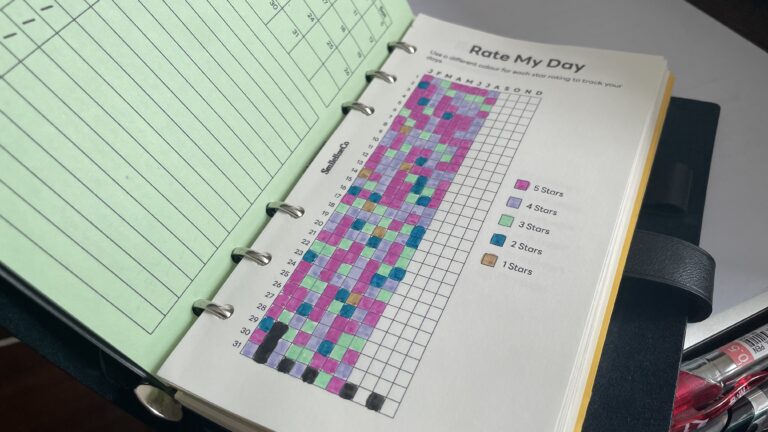
If you want a simple visual record, a Mood Tracker printable can give you a quick way to see your emotional history at a glance.

What About a 1–5 Rating?
You don’t always need to identify a specific emotion. Sometimes you just know: “Today was good.” or: “Today was rough.” That’s enough.
A simple rating system can make tracking almost effortless.
For example:
1 — Very difficult
2 — Difficult
3 — Okay
4 — Good
5 — Excellent
A tool such as Rate My Day is useful if you want the lowest-friction version of mood tracking. You don’t have to ask yourself ten questions. You simply rate the day.
How Long Should You Use a Mood Tracker?
There is no magic number. But there’s an important principle: The longer you track, the more opportunity you have to notice recurring patterns.
A few days can tell you about a few days. A few weeks may start revealing short-term patterns. Several months give you a much broader perspective. This is why visual trackers can be useful. Instead of reading dozens of journal entries, you can look at the whole period at once.
The APA has noted that monitoring mood can help people understand emotional patterns, while structured diary approaches are also useful for capturing experiences over time rather than relying entirely on later recall.
How to Actually Use Your Mood Tracker
The biggest mistake is treating the tracker as the destination. It’s not.
The tracker is the observation tool. The interesting part comes later.
For example:
Step 1 – Record your mood.
Step 2 – Do it consistently.
Step 3- Look back.
Step 4
Ask: “What keeps repeating?” Maybe you notice that your mood dips every Sunday.
That’s when you move from: Tracking to: Pattern recognition.
And that’s where the real value begins.
Don’t Judge the Data
Your tracker isn’t a report card. A week full of low ratings doesn’t mean you “failed.” A week full of high ratings doesn’t mean you’re doing everything right. You’re simply collecting observations.
Try to look at your tracker like a scientist looking at a chart: “Interesting.” rather than: “I’m terrible.”
That small change in attitude matters. The purpose of self-monitoring is observation—not self-criticism.
A Simple Mood Tracking Experiment
Want to try it? For the next 30 days, record:
1. Your overall mood
2. A 1–5 rating
3. One thing that affected your day
That’s all.
At the end of 30 days, don’t immediately try to change everything.
First, look. What do you notice? What surprised you? What repeats? What doesn’t? You might discover something important. Or you might discover that your mood is much less predictable than you expected.
Either way, you’ve learned something about yourself. And that is the real purpose of mood tracking.
Your Mood Is Data—Not a Verdict
A mood tracker doesn’t tell you whether your life is good or bad. It doesn’t diagnose anything. It doesn’t predict the future. It simply gives you another way to observe yourself.
Instead of: “I always feel like this.” you may eventually be able to say: “I’ve noticed this tends to happen under these circumstances.” That’s a much more useful statement.
Because once you can see a pattern, you can start asking a better question: What happens if I zoom out and look at the bigger picture? That’s where 30 days of mood tracking becomes much more interesting.
Frequently Asked Questions About Mood Tracking
1. What is a mood tracker?
A mood tracker is a tool used to record your mood or emotional state regularly over time. It can be as simple as a daily 1–5 rating or a chart where you record specific emotions. The purpose is to help you observe changes and patterns rather than relying entirely on memory.
2. How does a mood tracker work?
A mood tracker usually asks you to record your mood at regular intervals, such as once a day. You might choose an emotion, give your day a rating, or add a short note about what happened. After several weeks or months, you can review the record to look for recurring patterns, changes, or possible influences.
3. How often should I track my mood?
There is no single schedule that works for everyone. Daily tracking can make patterns easier to see, but the most useful frequency is one you can maintain consistently without feeling overwhelmed. For beginners, a simple once-a-day check-in is often an easy place to start.
4. What should I track in a mood tracker?
You can keep it very simple. Start with your overall mood, a 1–5 rating, and one thing that may have influenced your day. You can add sleep, exercise, social activities, stress, or other context later if those details are useful to you.
5. Is mood tracking actually helpful?
Mood tracking can be useful as a self-observation and reflection tool, particularly for noticing patterns over time. However, research does not show that mood monitoring by itself reliably improves depression or bipolar symptoms. A 2026 systematic review found limited evidence for meaningful symptom changes, so it’s better to view mood tracking as a way to collect observations rather than a treatment.
6. Can a mood tracker diagnose depression or another mental health condition?
No. A personal mood tracker is not a diagnostic tool. Persistent or severe symptoms should be discussed with a qualified healthcare professional. The National Institute of Mental Health recommends seeking professional help when severe or distressing symptoms persist or interfere with daily life.
7. Is a mood tracker better than a mood journal?
Neither is automatically better. A mood tracker is usually faster and more structured, while a mood journal gives you more space to describe thoughts, events, and experiences. Some people use both: a quick daily tracker for consistency and journaling when something needs more reflection.
Next:
[How to Track Your Mood: A Simple Daily Mood Check-In]
[30 Days of Mood Tracking: What I Learned About Me]
Note: Mood tracking is intended here as a self-reflection and awareness practice. It isn’t a substitute for diagnosis or professional mental-health care.