Vegetables in China: What $22 Really Buys in a Week
Can we buy a week of vegetables in China with just 22 dollars? On a weekend morning in Changsha, my husband and I decided to find out.
We gave ourselves a simple challenge: spend no more than 150 RMB (about $22) to buy enough vegetables for our family of three for the week. The catch? We only had the time while our daughter was in her calligraphy class at the Children’s Palace.
Spoiler: we did it, and we even had 19 RMB left over.
Hi, I’m Smile! I live in Changsha, China, and today I’m taking you along on an ordinary weekend morning in our family’s life. I also made a video of this day, using my own English for the very first time, so please bear with me if it isn’t perfect.
A quick note: this post contains a few affiliate links. If you buy through them, I may earn a small commission at no extra cost to you. I only included things that appeared in this day or that we actually talk about here.
The Short Answer: Did We Make It?
Yes. Here is the quick version:
- Budget: 150 RMB (about $22)
- 10 kinds of vegetables: 78 RMB (less than $12)
- Plus grapes, mandarins, tofu, dried tofu, and breakfast
- Total spent: 131 RMB (less than $20)
- Left over: 19 RMB
I’ll walk you through all of it below, from the Children’s Palace to the market stalls, including the little moments that made it feel like a real weekend.
Our $22 Challenge: A Week of Vegetables in China
It was the weekend, and we had to drive about four kilometers (roughly two and a half miles) to get our daughter to the Children’s Palace before 8:30.
We got up a little late. So we got ready fast, packed her class supplies, and rushed out the door. There was no time to make breakfast, so we picked up some steamed buns on the way and ate them in the car.
Our daughter had two calligraphy classes that morning:
- First class: soft-pen (brush) calligraphy, 8:30 to 10:00
- Second class: hard-pen calligraphy, 10:10 to 11:40
There is only a ten-minute break in between, but each class lasts a full hour and a half. That gave my husband and I an idea. During just one class, could we take 150 RMB to the market near her school and buy enough vegetables for a whole week?
A note on the money: I used about 6.8 RMB to the US dollar in this post. Exchange rates change every day, so please treat the dollar amounts as approximate.
What Is a Children’s Palace in China?
If you’ve never heard of a Children’s Palace, don’t worry. I’ll explain it quickly.
A Children’s Palace (少年宫, shàoniángōng) is a public activity center for kids. Many cities in China have one. On weekends, children can take all kinds of classes there: hosting, dance, calligraphy, painting, and more. Think of it as a place where kids can explore their interests outside regular school.
Our daughter goes to the Children’s Palace for calligraphy. If you are curious about the Children’s Palace in China, our visit is a very ordinary example of how many families spend a weekend morning.
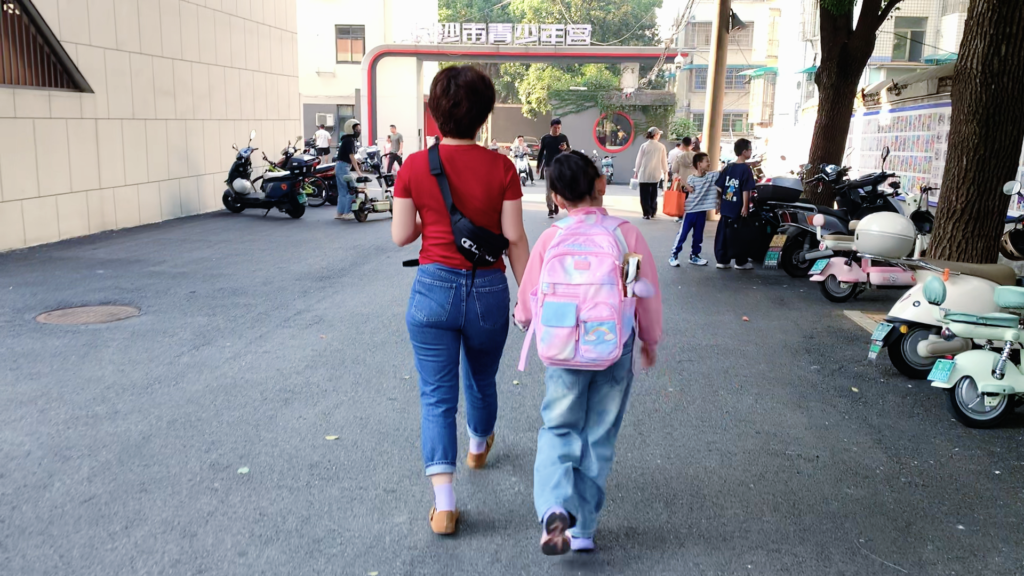
The Children’s Palace, where our daughter takes her weekend classes.
Soft-Pen vs. Hard-Pen Calligraphy
Our daughter’s morning had two very different kinds of writing.
Soft-pen calligraphy means the brush. You dip it in ink, and the pressure changes with every stroke, so each line has its own weight. In China, the brush, ink, paper, and inkstone are sometimes called the “four treasures of the study” (文房四宝).
Hard-pen calligraphy means pens and pencils. The tip stays firm and doesn’t change shape, and it’s the kind of writing we use every day, like homework.
So in one morning, she practiced both. If you are looking for a calligraphy class for kids, many Chinese families start with one of these two styles, and some, like us, do both.
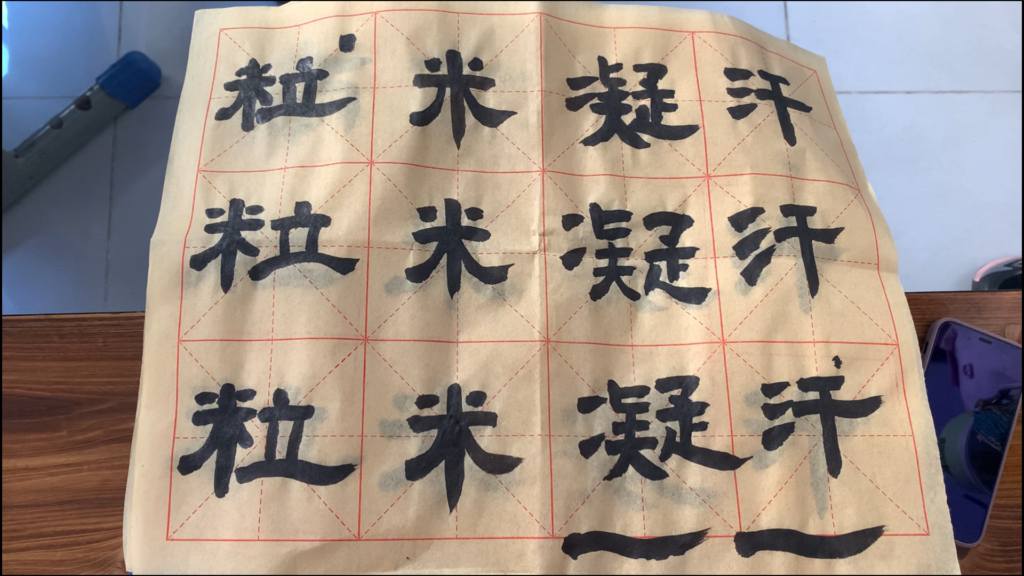
Soft-pen (brush) and hard-pen: two ways of writing.
Inside a Chinese Wet Market on a Weekend Morning
After we dropped our daughter at her classroom, our market challenge officially began.
The market is less than a kilometer from the Children’s Palace. In Chinese it’s called a càishìchǎng (菜市场), which literally means “vegetable market,” but English speakers often call it a Chinese wet market. It’s a place full of fresh vegetables, fruit, meat, tofu, and more.
Inside, the little lanes keep going, one after another, and on a weekend morning it’s so crowded you can barely turn around. And there is so much food. As you walk down the street, all the smells hit you at once, and everything looks so good that you want to try it all.
One thing to know: vegetables here are sold by the jin (斤). One jin is 500 grams, which is a little more than a pound.
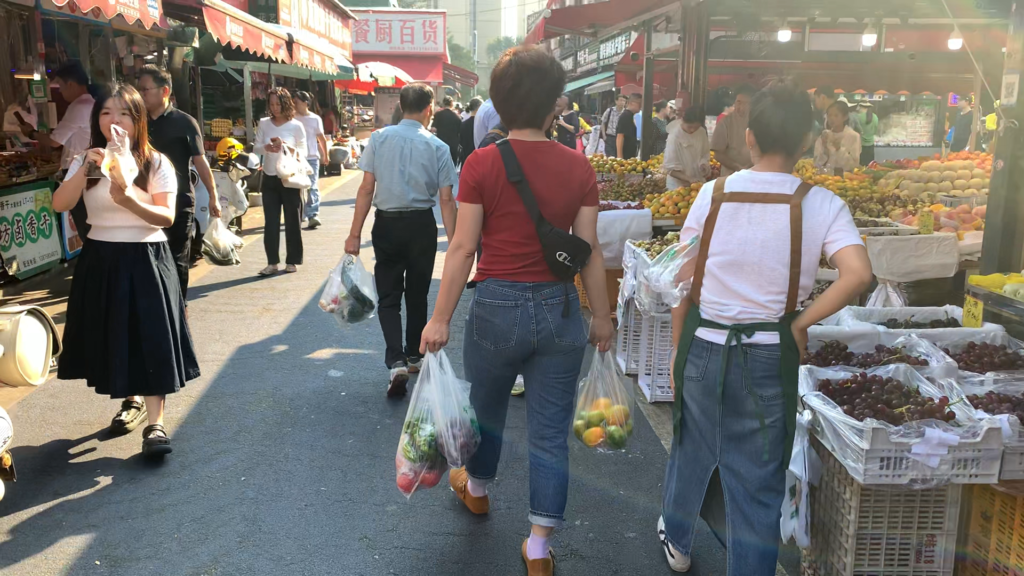
A weekend morning at our local Chinese wet market.
Our Favorite Stall
We’ve shopped here a few times after dropping our daughter off, so we know our way around.
There’s one stall we really like. The owner is super friendly and always looks out for us. She tells us which vegetables are fresher and tastier, and sometimes she even throws in a few extras. So, of course, my husband headed straight to her stall again.
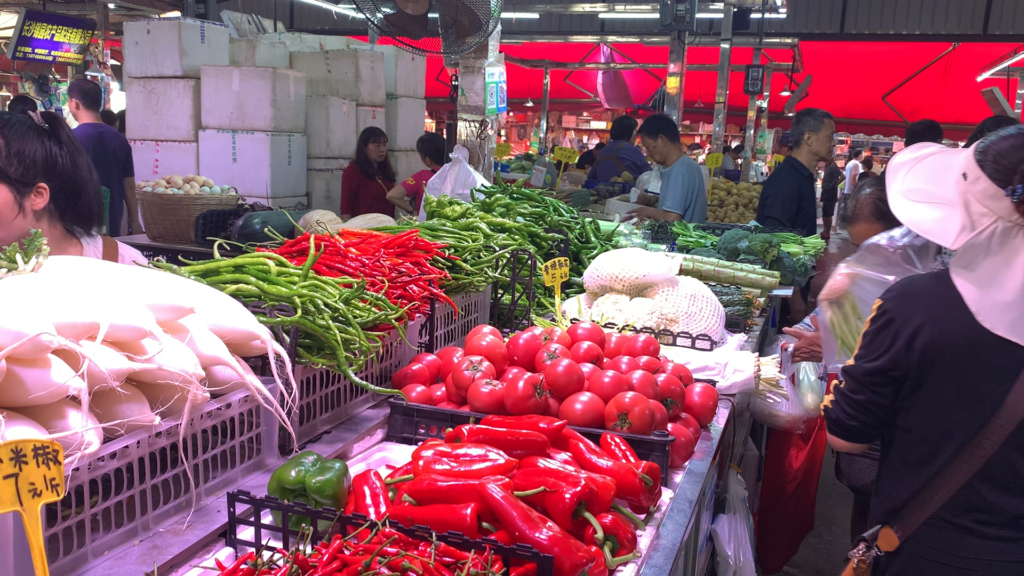
Our favorite stall, where we usually buy most of our vegetables.
Hunan Chili Peppers: The Soul of Our Kitchen
All three of us are from Hunan. In a Hunan home, chili peppers are probably the most common thing on the table. Hunan cuisine (湘菜, xiāngcài) is known for bold, spicy flavors, and honestly, chilies are the soul of it. If you’d like to read more about the cuisine, this overview of Hunan cuisine is a good place to start.
So my husband picked out three kinds of Hunan chili peppers.
Chaotianjiao (朝天椒)
This little red one is the hottest of the three. It’s called chaotianjiao, which literally means “facing heaven chili,” because of the way it grows. You might know it as a bird’s eye chili.
Luosijiao (螺丝椒)
This long green one has wrinkly skin, like a twisted screw, which is where the name comes from. It’s called luosijiao, and it’s great for stir-fried pork, a classic home-style dish in Hunan.
Qingxianjiao (青线椒)
And here’s the third chili. It’s green, long, and thin, and we use it as a side ingredient. It’s called qingxianjiao.
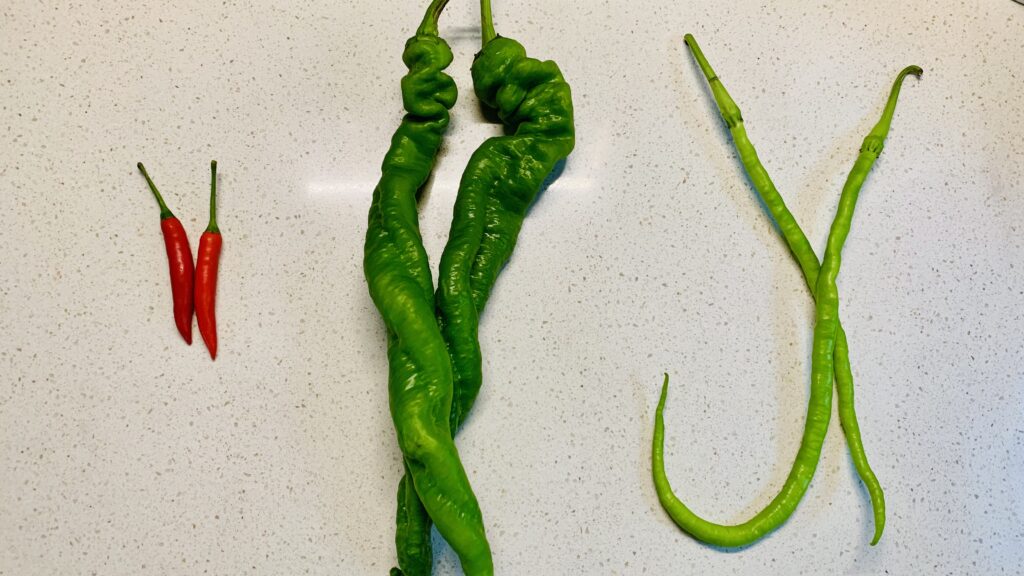
Three Hunan chili peppers: chaotianjiao, luosijiao, and qingxianjiao.
The Rest of Our Vegetable Haul
While my husband was picking chilies, the owner recommended a vegetable called qixinbai (齐心白). It’s a type of Chinese cabbage. She told us even her two-year-old loves it, so my husband bought some.
Then we picked a few tomatoes, and the owner chose a loofah for us herself. (Yes, the same plant as the bath sponge, but when it’s young, it’s a vegetable we cook and eat.)
I like garlic as a side, so he grabbed some of that, too. Potatoes are a regular on our table. And our daughter loves cauliflower and broccoli, so those were a must.
That made ten kinds of vegetables in total:
- Chaotianjiao (朝天椒)
- Luosijiao (螺丝椒)
- Qingxianjiao (青线椒)
- Qixinbai (齐心白, a type of Chinese cabbage)
- Tomatoes
- Loofah
- Garlic
- Potatoes
- Cauliflower
- Broccoli
Just before we paid, I spotted a dog sitting on a cutting board at the stall next door. So cute!
How We Paid at the Chinese Wet Market
Ten kinds of vegetables came to 78 RMB, which is less than 12 dollars.
You might have noticed how we paid. Like most people here, we just scanned the seller’s QR code with our phones, using a mobile payment app such as WeChat Pay or Alipay. Some older folks still carry cash now and then, but for us, going out with just a phone is totally normal.
(I blurred the sellers’ payment codes in the photos and video out of respect for their privacy.)
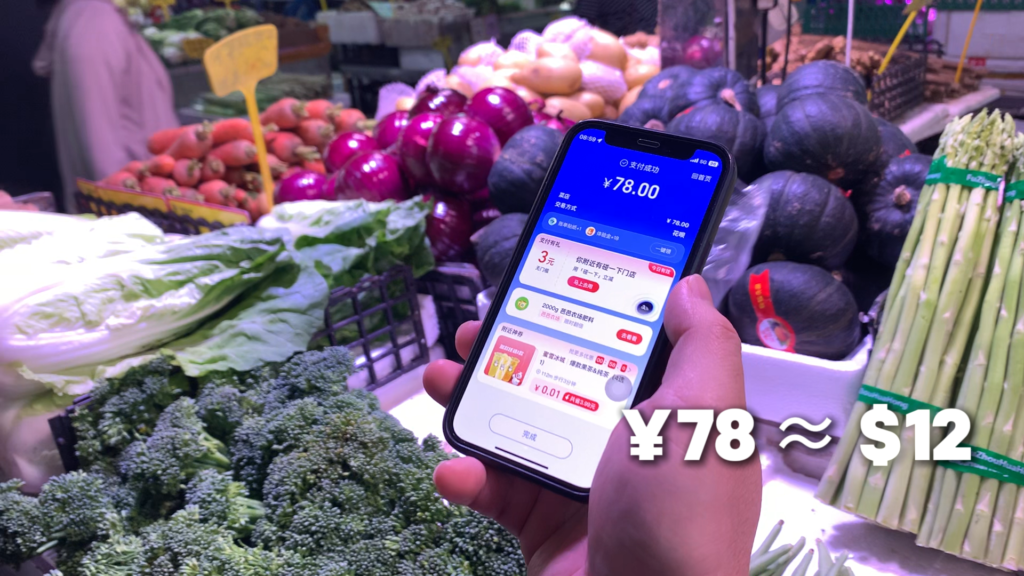
Paying by phone at the market. The payment code is blurred.
Fruit, Tofu, and Breakfast
With the vegetables done, we picked up some seasonal fruit:
- Grapes: 19.4 RMB (under $3)
- Mandarins: 14.6 RMB (about $2)
By now our hands were already full, and the crowd kept getting bigger. It was October, but it was 31 degrees Celsius that day (about 88 Fahrenheit), so it was getting hot.
One more stop for tofu. We bought the tofu and dried tofu our daughter loves for 11 RMB (about $1.60). On our way back, we passed a breakfast shop that smelled so good we stopped for some breakfast: 8 RMB (a little over a dollar).
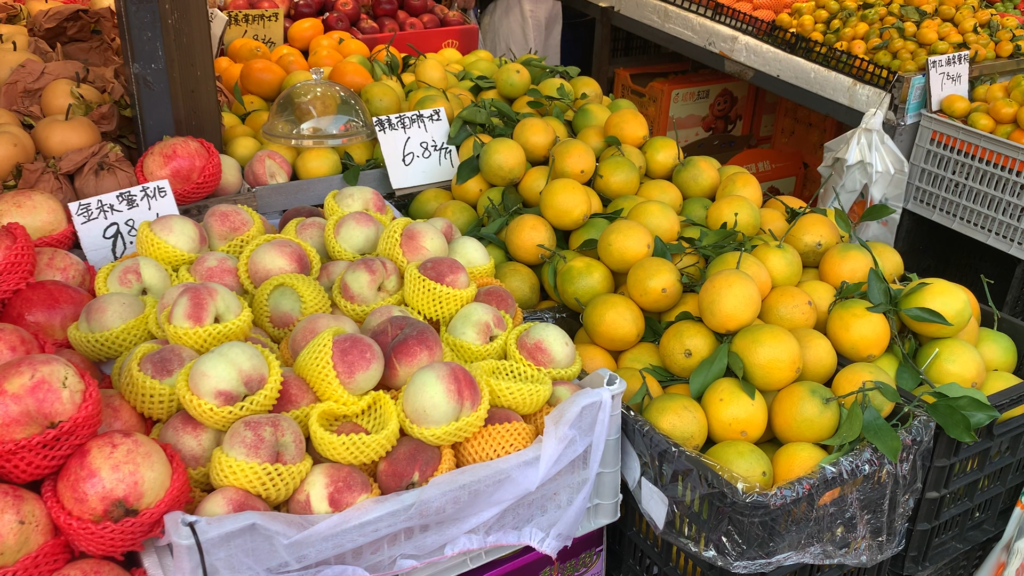
Grapes and mandarins, our seasonal fruit for the week.
My husband kept muttering that we hadn’t checked out the seafood section. But our mission that day was vegetables, and we were really efficient. We finished shopping at 9:20, put everything in the car, and he went into power-walking mode. We brought a few mandarins back for our daughter. They were really good, and they tasted like the ones we grew at home when we were kids.
The Final Total: What Vegetables in China Cost Us
Here is the full breakdown of our morning:
| Item | Cost (RMB) | Approx. USD |
|---|---|---|
| 10 kinds of vegetables | 78 | under $12 |
| Grapes | 19.4 | under $3 |
| Mandarins | 14.6 | about $2 |
| Tofu and dried tofu | 11 | about $1.60 |
| Breakfast | 8 | a little over $1 |
| Total | 131 | under $20 |
| Budget left | 19 |
Challenge complete! And that even includes the fruit and breakfast.
Of course, prices change by city, by season, and even by stall, so this is just what vegetables in China cost us on one weekend morning in Changsha.
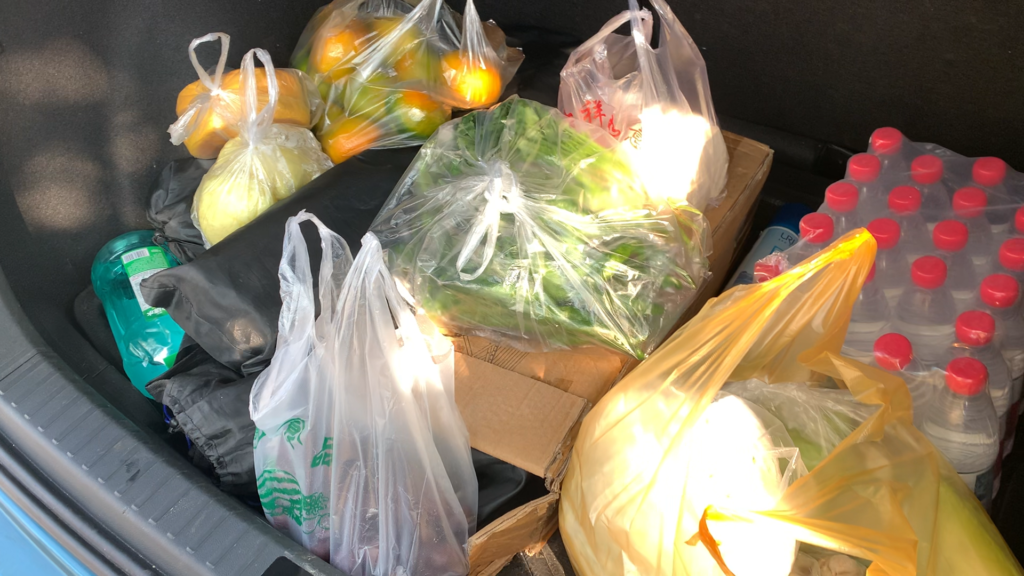
Our full haul. Total: 131 RMB, with 19 RMB left from our 150 RMB budget.
While We Waited: What We Usually Do
Because we spent today’s waiting time at the market, we still had a little time before our daughter’s break. Usually, we might check out the exhibits at the school, walk around the playground, bring a laptop and write blog posts, read on a Kindle (affiliate link), or just scroll on our phones until class is over.
If you like seeing slow, ordinary family days, you might enjoy our family day at the farm in Changsha, where we spent a weekend with our daughter outdoors.
晴耕雨读: A Gift From the Calligraphy Teacher
Then our daughter came running over, so excited. She told me that for the first time in a long time, she got through brush class without getting her hands dirty. I was so happy for her.
She couldn’t wait to show us the piece of calligraphy her teacher had given her. It says: 晴耕雨读 (qíng gēng yǔ dú).
Those four characters mean: farm the fields when it’s sunny, and read and write when it rains. It’s an old Chinese idea about making good use of whatever kind of day you’re given. It also connects to a traditional ideal of families who both farm and study (耕读传家).
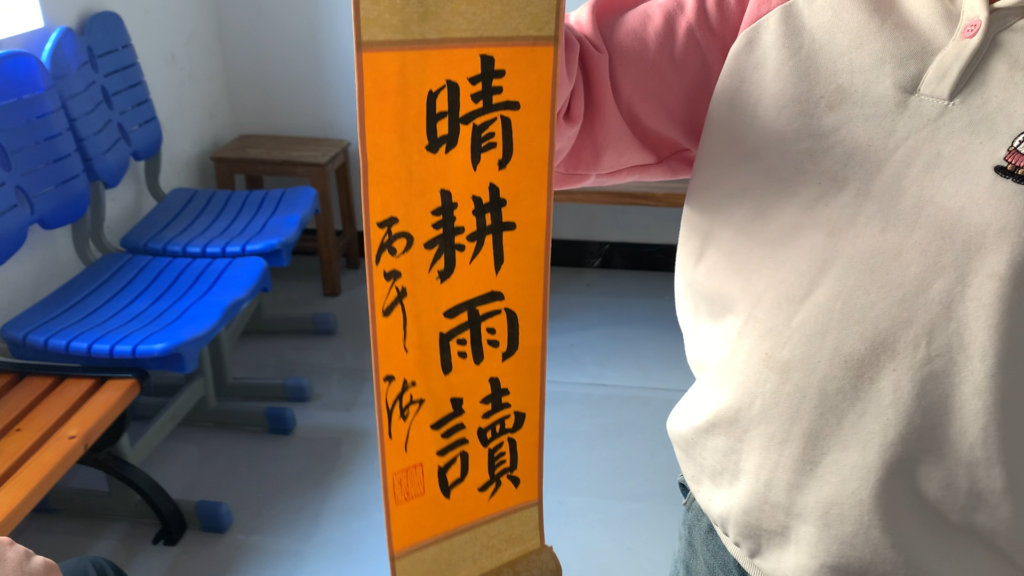
the calligraphy our daughter’s teacher gave her.
A Calligraphy Competition About China’s Grain
She also told us her teacher wants her to enter a competition. The theme is “Youth Protecting China’s Grain.” It’s about protecting China’s food supply and encouraging young people to value farming and food. Her teacher suggested she enter with both soft-pen and hard-pen.
Funny enough, we had just come from a market full of vegetables, and she was holding a piece of calligraphy about farming. That made me smile.
Her Clerical Script
She also showed us her soft-pen writing in clerical script (隶书, lìshū), one of the ancient styles of Chinese calligraphy. If you’re curious, you can read more about Chinese calligraphy and the clerical script.
I’m really proud of her. It’s really good. Honestly, it’s better than mine or her dad’s.
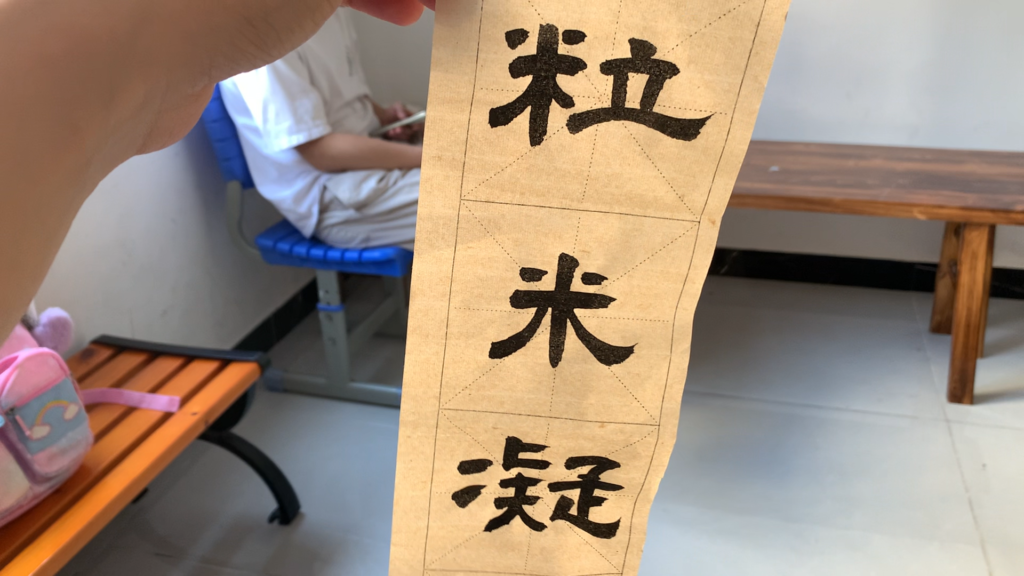
Soft-pen writing in clerical script.
The Waiting Room, the Fire Alarm, and the Display Wall
She packed up her bag and headed off to hard-pen class.
Next door, the school started playing its break-time exercise music, a familiar sound in many Chinese schools (课间操, kèjiān cāo). The parents in the waiting area were all quiet. My husband was getting sleepy, and he just lay down on the chairs and fell asleep.
He’s not much of a talker. But when it comes to loving and looking after our daughter, he doesn’t need words.
As the class was finally coming to an end, the man who had just woken up was still a little out of it. I noticed flowers on the roof across the way, which put me in a good mood. I also loved a little detail on the classroom windowsill.
And that’s the fire alarm outside the classroom. By the way, China’s emergency number for fire is 119. (Police is 110 and ambulance is 120.)
Then class was over! Our daughter walked out with her things, so happy to see us. On our way out, we noticed a display wall, and she spotted her own work and pieces from a few of her classmates. She said she hopes that one day, her soft-pen writing will be up on that wall, too.
I hope so, too! For now, I’m just happy to see her enjoying something she loves.
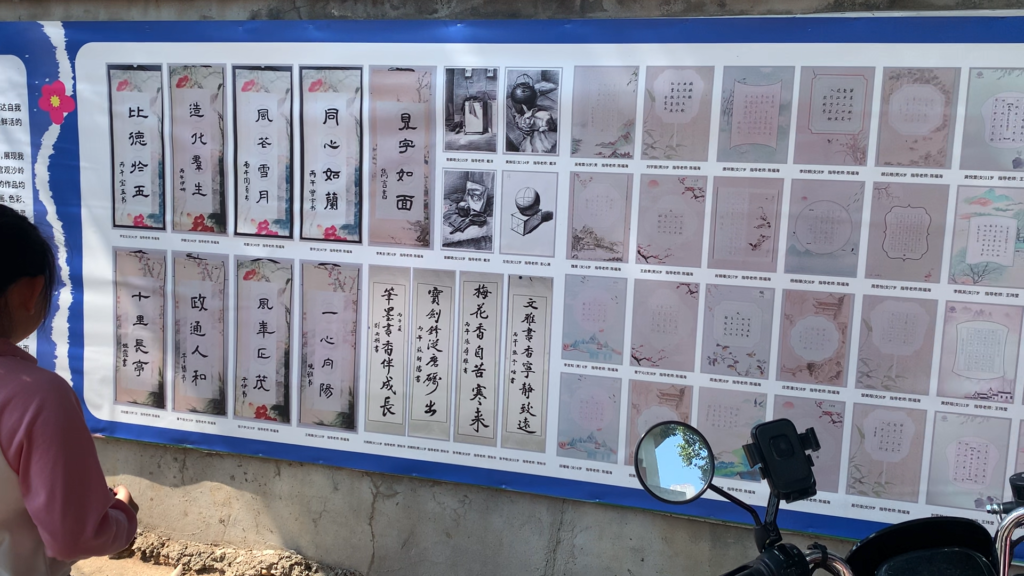
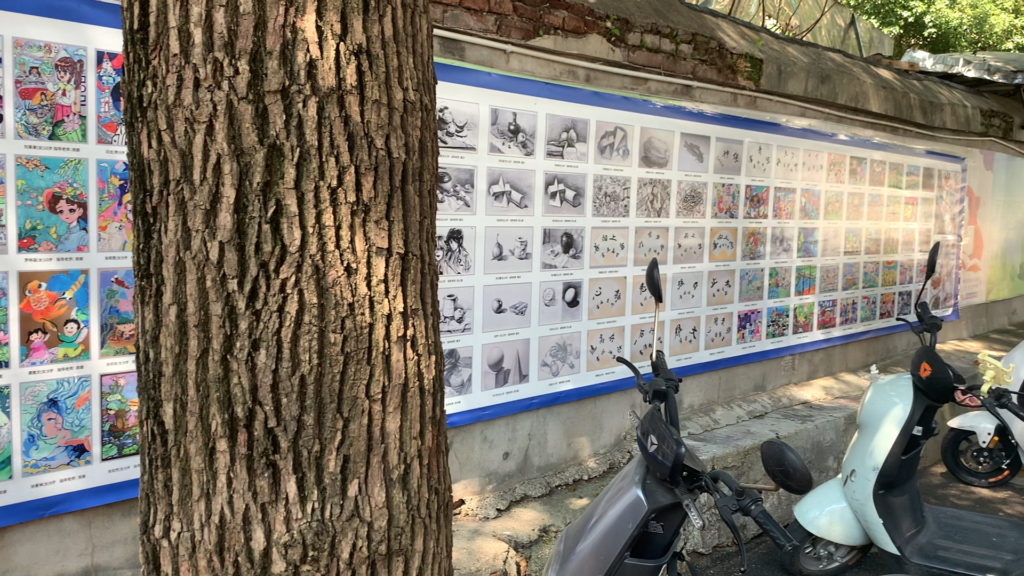
The display wall, where our daughter hopes to see her own soft-pen work one day.
Things From This Video
A few readers have asked what we use for calligraphy practice, so here are the things connected to this day. (As mentioned above, these are affiliate links.)
- Beginner brush pen for calligraphy
- Calligraphy practice paper
- Kids’ fountain pen for hard-pen practice
- Kindle (what I read on while waiting for class)
Frequently Asked Questions
How much do vegetables cost in China?
It depends on the city, the season, and the market. In our case, ten kinds of vegetables cost 78 RMB (less than $12) at a Chinese wet market in Changsha on a weekend morning in October.
What is a Chinese wet market?
A Chinese wet market (菜市场) is a market selling fresh vegetables, fruit, meat, tofu, and other everyday foods. Vegetables there are often sold by the jin, which is 500 grams. You can read a general overview of wet markets here.
What is a Children’s Palace in China?
A Children’s Palace (少年宫) is a public activity center for kids where they can take classes such as hosting, dance, calligraphy, and painting, often on weekends.
What’s the difference between soft-pen and hard-pen calligraphy?
Soft-pen calligraphy uses a brush and ink, and the pressure changes the thickness of each stroke. Hard-pen calligraphy uses pens or pencils with a firm tip, and is closer to everyday handwriting.
Do people in China still use cash?
At our market, most people paid by scanning a QR code with their phones. Some older people still carry cash now and then.
More From My Blog
If you enjoyed this morning with us, here are a few more stories:
- 👉 Chinese Mid-Autumn Festival: A Real Family Celebration in China
- 👉 Our $8.16 Family Dinner in China: The $10 Challenge
- 👉 A Family Bike Ride Around Songya Lake in Changsha
- 👉 Things to Do in Changsha With Kids: A Family Day Out at a Farm in China
Final Thoughts
So that was our morning in China. We dropped our daughter off for calligraphy, bought about a week of vegetables, plus fruit and breakfast, for less than 20 dollars, and somehow fit it all into one morning.
It was just an ordinary weekend morning for our family, but I hope you enjoyed coming along. Now I’d love to hear from you: what would you buy first at a Chinese wet market? Let me know in the comments.
Thank you so much for spending your time with us. See you next time! ❤️
A little note from SmilelineCo:
Printables, graphics, and design elements on this site are created by Smile of SmilelineCo and are for personal use only. Please don’t alter them, resell them, or redistribute them, for free or for profit, without written permission from me. If you’d like to share something with a friend, family member, or your community, please share the link to this blog post or to the shop page instead of the files themselves. Thank you for supporting my shop. Wishing you a wonderful life. ❤️