How to Use the Feynman Technique for Difficult Books
Have you ever finished a chapter and thought: “I read every word. So why can’t I explain what I just read?”
I’ve been there. You underline sentences. You add sticky notes. You reread the same paragraph. And somehow, the more you read, the less confident you feel.
The problem may not be that you’re a bad reader. Sometimes the book is simply asking your brain to do more work than passive reading can handle. That’s where the Feynman Technique for difficult books comes in, it forces you to slow down and actually prove you understood what you read.
First: Stop Trying to Understand the Whole Book at Once
This is probably the single biggest mistake people make with difficult books.
They tell themselves: “I’m going to understand this book.“
That’s a bit like saying: “I’m going to understand physics.“
Way too big a target.
Shrink it instead. Ask:
“What is the author actually trying to explain in this chapter?”
Then:
“What’s the main idea of this section?”
Then:
“Can I put this idea into my own words?”
Suddenly you have a task you can actually finish.
Step 1: Read for the Big Idea First
Before you get lost in every sentence, scan:
- the chapter title
- section headings
- introductions
- summaries
- diagrams
- examples
Then ask yourself:
“What question is this chapter trying to answer?”
This lines up well with active reading strategies more broadly. Caltech’s active reading guidance recommends previewing a text, asking questions before you dive in, and paraphrasing sections as you go.
Step 2: Close the Book
Here’s the uncomfortable part.
Close the book. Now explain the idea out loud, without peeking.
Don’t try to recite the author’s exact words.
Instead, start with:
“The author is basically saying…”
That one sentence works wonders as a starting point.
Keep going from there. If you can walk through the argument in plain language, you’re making real progress.
And if you can’t? That’s not failure. That’s information, it tells you exactly where to focus next.
Step 3: Find the Sentence That Broke You
Sometimes an entire chapter feels unclear because of one missing piece, not the whole thing.
Maybe the author assumes you already know:
- a historical event
- a mathematical concept
- an economic term
- a philosophical idea
- an earlier argument in the book
You keep reading, but that one gap quietly follows you through the rest of the chapter. This is exactly what the Feynman approach helps you pinpoint.
Instead of thinking:
“This whole book is too hard for me.”
You can narrow it down to:
“I don’t understand this one relationship.”
And that’s a problem you can actually solve.
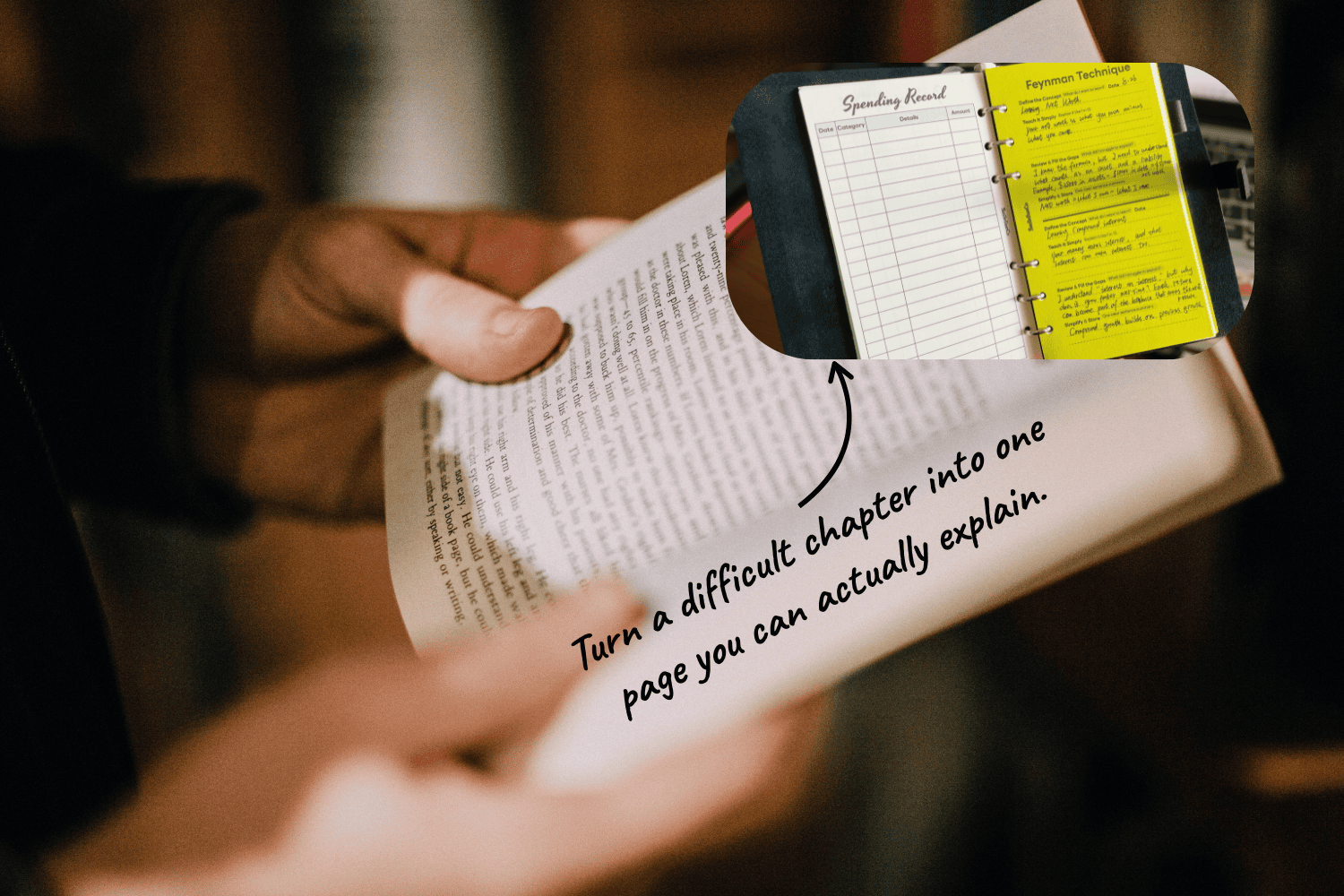
Use one Feynman learning cycle for one difficult idea instead of trying to summarize an entire book at once.
Step 4: Explain It Like You’re Talking to a Friend
Picture a friend asking you:
“Okay, so what is this chapter actually saying?”
Don’t hand them the polished, academic version. Give them the version you’d actually say over coffee.
For example, instead of:
“The author argues that incentives influence individual behavior within institutional structures…”
Try:
“Basically, people respond to the rewards and consequences around them — so if you change the incentives, you change what people do.”
Then ask yourself:
Did I lose anything important in translation?
If yes, add it back in.
If no, congratulations, you’ve just made the idea far easier to work with.
Step 5: Create Your Own Example
This is where difficult books really start to open up.
Say you’re reading about opportunity cost. Don’t stop at the textbook definition.
Build your own example instead:
“If I spend Saturday working, I give up the chance to spend those hours with my family — or on another project I care about.”
Now the abstract idea has somewhere real to live in your memory.
Creating your own examples like this also lines up with learning research that emphasizes concrete examples and elaboration as tools for retention.
What If the Book Is Still Confusing?
Good.
Genuinely, that’s fine. You don’t need to understand every sentence on the first pass.
Try this instead:
Pass 1
Get the general argument.
Pass 2
Flag the sections that still feel fuzzy.
Pass 3
Run the Feynman Technique on just those specific ideas.
Pass 4
Go back to the book and see if the argument clicks now.
This is far more efficient than starting from page one every single time you get stuck.
A Feynman Technique Reading Example
Say you’re reading a book on behavioral economics.
The chapter covers: loss aversion.
You close the book and write:
“People tend to feel losses more strongly than equivalent gains.”
Then you pause.
You realize:
“Wait — what does ‘more strongly’ actually mean here?”
That’s your gap.
So you go back and dig into the concept.
Then you build an example:
“Losing $100 might sting a lot more than gaining $100 feels good.”
Try explaining it again.
Then push a little further:
“Why would this actually matter when people make financial decisions?”
And just like that, you’re no longer just reading, you’re actively working with the idea.
Don’t Turn Every Book Into Homework
One more trap worth naming here.
The Feynman Technique is genuinely useful, but you don’t need to turn every novel, essay, or relaxing weekend read into a study project.
Save it for the books you actually want to understand deeply. Good candidates include:
- business books
- economics books
- psychology
- philosophy
- science
- history
- technical books
- professional development
Reading a novel purely for pleasure? Just enjoy the story.
You don’t need a worksheet to tell you how you feel about the ending.
Use One Page for One Learning Problem
This is actually why I built the worksheet around learning cycles instead of pages of notes.
You don’t need to transcribe everything the author said. You just need to capture:
What am I trying to understand?
Can I explain it?
Where did I get stuck?
What’s the clearer version?
The current worksheet gives you two full cycles on a single page, so you can use it for two different concepts, or come back and work through the same concept twice.
[Feynman Technique Printable Worksheet →]
A Better Way to Take Notes From Difficult Books
Instead of filling pages with copied notes, try this structure instead:
The idea
What is the author actually saying?
My explanation
How would I put it in my own words?
The gap
What don’t I fully understand yet?
My example
Where does this show up in real life?
One-sentence summary
What’s the idea in its simplest, most useful form?
That last sentence tends to become surprisingly valuable when you revisit the book months later.
The Goal Isn’t to Sound Smart
This might be the most important lesson of all.
A difficult book can tempt you into borrowing the author’s language.
You catch yourself writing:
“The epistemological implications…”
simply because that’s what’s on the page.
Instead, ask yourself:
“Could I explain this to a smart friend who hasn’t read the book?”
If the answer is no, you’re not done yet. Understanding doesn’t always make an idea shorter. But it almost always makes it clearer.
Final Takeaway
Next time you catch yourself rereading the same paragraph for the fourth time, stop.
Close the book. Ask:
“What is this actually saying?”
Explain it. Notice exactly where you get stuck.
Go back. Fix that one gap. Then explain it again. That’s the Feynman Technique at its most useful.
Not a complicated study system, just a simple habit of refusing to mistake familiarity for understanding.
[The Feynman Technique: How to Actually Understand What You Learn →]